
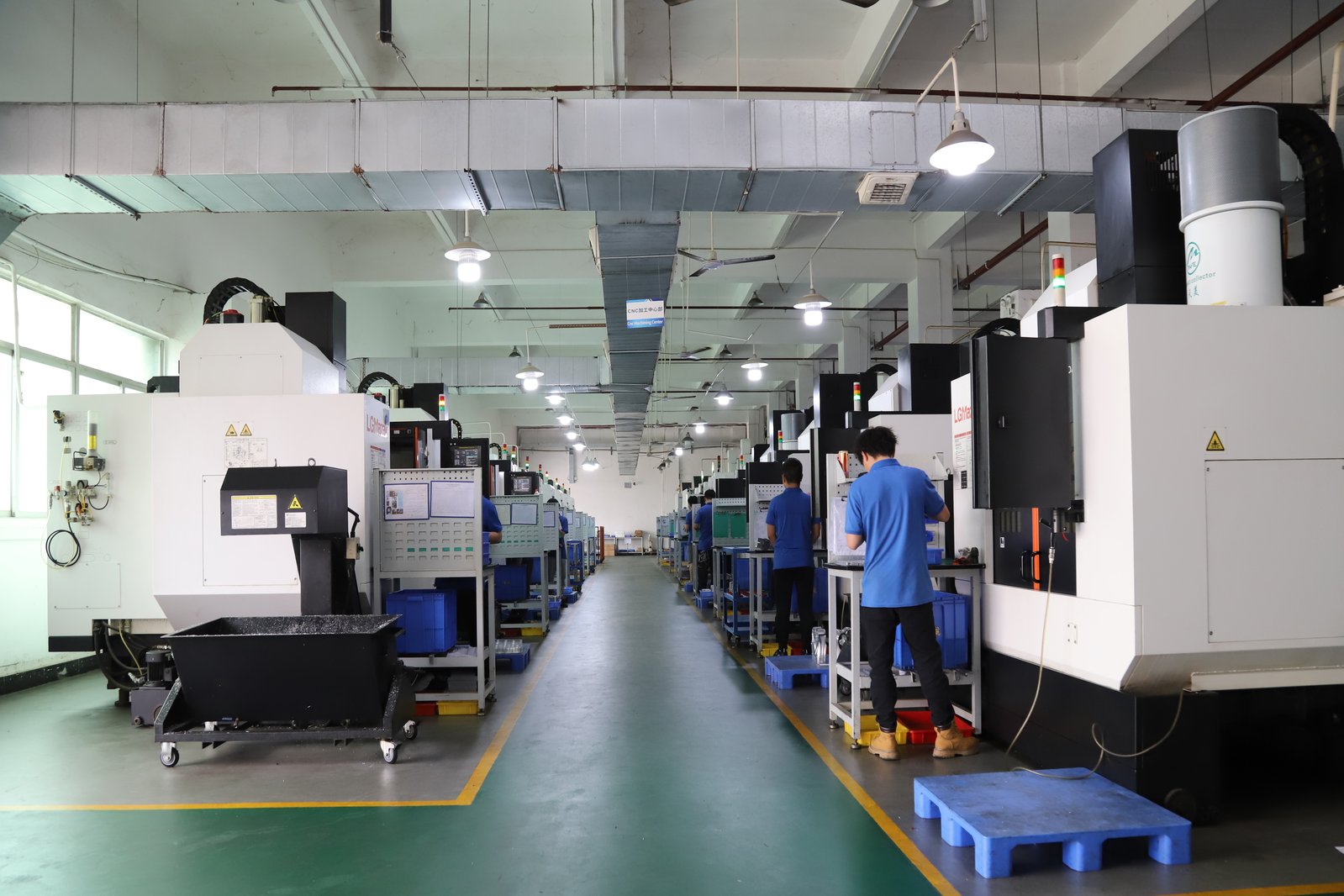
Buying precision machining from a factory in China puts the buyer one step closer to the cost than buying from a trading desk, but only if the quote can be read. A factory-direct price is the sum of material, machining time and the cost of proving the part is right, and each component is driven by decisions the buyer controls. This guide takes those decisions in order, explains what the numbers in a factory quote actually pay for, and ends with a method for comparing prices across factories that survives contact with a real drawing. The discipline is the same in 2026 as in any year: quotes are compared on structure, and first lots are judged on evidence.
What does a factory-direct quote actually pay for?
A machining quote is not a rate per kilogram; it is three costs added together. Material is the certified bar or billet with its certificate chain. Machining time covers the operations your geometry demands — turning, milling, drilling, threading, grinding — priced against the factory's machine-hour cost, which is why a feature that needs a special tool or a slower feed appears on the quote even though it adds no weight. The third component is inspection and documentation: the dimensional report, the material certificate and the quality-system overhead that a certified factory carries on every order.
Buying direct from the factory removes the trading markup and shortens the chain of questions, but it also means the quote is the factory's own arithmetic, and that is exactly what you want to read. A factory quote that names the material, the process steps and the included documentation is a quote you can compare; one that returns a single number with no structure is a number you cannot audit. Ask for the breakdown, because the breakdown is where the factory shows whether it understands your part or is pricing your hopes.
Why does the same part cost differently across factories?
Two factories quoting the same drawing will rarely return the same number, and the spread is information, not noise. Part of it is real capability: a factory that has run your geometry before quotes from experience, while one meeting it for the first time prices the learning curve. Part of it is process choice: one factory may plan the part in two setups while another holds it in one, and the setup count is cost. And part of it is assumption: factories that do not ask questions make assumptions, and the assumptions — about material grade, inspection depth, finishing interpretation — land in the quote.
The buyer's defense is to make the assumptions explicit before the quotes arrive. Send every factory the same complete package — the model, the toleranced drawing, the material grade and condition, the quantity, the finishing spec — and ask each for its breakdown. When the numbers still differ, ask why: the factory that explains its process choice has a process; the one that cannot explain the gap is quoting a different part that happens to share your drawing number.
How much does the material choice move the price?
Watch the buy quantities hiding inside the numbers. Bar and plate come in standard sizes, and a part that leaves a large share of the stock on the floor carries that waste in the material line; a design that nests efficiently into standard stock removes it. Ask the factory what the material utilization looks like and whether the quote is built on standard stock sizes. A factory that shows how the part fits the stock is pricing reality; one that rounds the material cost upward may be charging you for scrap your geometry does not create.
Material is usually the first and largest line, and the grade you name decides it. Aluminum such as 6061-T6 sits at the low end of both material and machining cost, which is why it dominates brackets and housings. Stainless costs more as raw material and more to machine — slower speeds, more tool wear — so the same geometry in 304 or 316L quotes visibly higher. The high-strength and high-temperature alloys sit higher still: 17-4PH above the austenitic grades, and titanium Ti-6Al-4V and the nickel alloys such as Inconel 718 at a multiple of aluminum's material price plus much longer cycles.
Inside the same family, the condition and stock form move the number. 7075-T7351 stress-relieved stock costs more than 6061-T6 but can be cheaper than machining a stressed piece that distorts and needs rework. Bar versus plate, hex versus round, and the section size you choose all change the buy quantity and the waste. Name the grade, condition and stock form once and send the same spec to every factory, or the quotes you compare will be pricing different materials that happen to share a name.
How do tolerance and inspection shape the number?
Tolerance is the second-largest driver and its effect is nonlinear. A capable China factory holds ±0.003 mm on milling and turning and ±0.002 mm on precision grinding with Ppk ≥ 1.67 at the initial study on key characteristics and Cpk ≥ 1.33 on general characteristics. Capability is reported per characteristic: every report names the feature, its tolerance band, the sample size, the sigma method, and the study window., but every feature pulled into the tight band adds inspection cost and a slower, more careful process. Moving one critical bore from a general tolerance to ±0.003 mm is asking for a different manufacturing plan on that feature, not a slightly better version of the same one.
The cost mistake is tightening everything at once. Blanket tight callouts force full inspection on features the assembly never checks, and the quote reflects it. Use geometric tolerancing to control the features that function and leave the rest to sensible general tolerances, and the price drops because the inspection plan drops. Ask the factory which features drove the tight-band cost — the design-for-manufacturing review should tell you where the tolerance budget is spent and where it can be recovered without changing function.
What does quantity do to the unit price?
Inspection is a real line in a precision factory's quote, and it deserves its own question. Which characteristics are verified on a CMM, which on gauges, which by sampling, and what instrument reports each one? A factory that names the instrument for the ±0.003 mm feature is showing you where the inspection cost went; one that quotes a flat percentage for quality is not telling you what it will actually measure. Ask for the inspection plan with the quote — it is the part of the price that becomes the part of your report.
Quantity works through setup amortization and process efficiency. Every order carries setup cost — programming, fixturing, first-article inspection — divided across the units. At a quantity of one, setup is the whole story; at a hundred, it is a rounding error. A larger run also justifies better fixturing and statistical process control, which lower the per-unit machining time and inspection cost. That is why unit price falls steeply from one to a few dozen parts and flattens as the run grows.
The practical lesson is that the crossover between a development order and a production order depends on your quantity, not on a magic number. For a handful of parts the quote is dominated by setup and engineering review, so the difference between factories is mostly capability and responsiveness. For a run in the hundreds or thousands, per-unit machining time and material utilization dominate, and a factory that has run your geometry before will quote meaningfully less than one meeting it for the first time. Ask each factory to quote the same part at your quantity and at a larger one; the shape of the curve shows where its efficiency sits.
How do finishing and secondary operations add up?
The machined part is rarely the shipped product. Anodizing, passivation, plating, powder coating and bead blasting each add a process and a process certificate, and the ones farmed out to specialty partners add a vendor and a schedule step. Surface treatment commonly adds a meaningful share of the part cost on finished components, and the spread between factories usually comes from the clarity of the finishing spec rather than the price of the coating itself.
The lever is specification. An anodize callout that names the class and color removes ambiguity; a drawing that says "black anodize, good quality" invites three interpretations and three prices. Ask whether the finishing is in-house or with a qualified partner, what certificate accompanies it, and how the coating affects the tolerance of the features under it — anodize grows a layer, so a tightly toleranced bore anodized after machining changes size unless the drawing accounts for it. Finishing is where quote comparison fails most often, because factories quote different interpretations of the same two-word callout.
What does design-for-manufacturing save before the quote arrives?
The cheapest part to machine is the one designed to be machined, and your drawing moves the price more than any negotiation. Internal corners with a radius larger than the cutter, hole depths within reasonable ratios, wall thicknesses that do not flex under cutting force, thread depths standard taps can reach, and datum structures that survive one setup instead of three — each removes cost before the factory ever prices it. A drawing that arrives DFM-clean quotes lower from every factory, because every factory prices the same machining reality.
A serious factory runs a design-for-manufacturing review as part of quoting and tells you where the cost is: the undercut that needs a special tool, the thin wall that needs a slower feed, the tolerance that forces an extra inspection pass. That review is free engineering that arrives before you commit. Compare the DFM notes between quotes — the factory that finds the expensive feature and proposes the fix is reducing your next order's cost; the one that quotes it silently is charging you for the lesson you will learn at the first article.
How do you compare factory quotes and reach the landed cost?
Design-for-manufacturing savings also compound across orders. A drawing improved once — radius opened, datum moved, tolerance allocated — quotes lower on every future order from every future factory, because the drawing itself changed. Treat the DFM notes from your first quote as engineering input to the design file, not as a one-off comment: the factory that shows you the cheaper geometry is offering you a permanent cost reduction that survives any change of supplier.
Compare quotes on a fixed structure, not on the total. For each factory, record the material grade and condition and its certificate, the tolerance per critical feature and its instrument, the process steps in the price, the finishing spec and its certificate, the inspection report included, the quantity assumptions, and the Incoterm. Then compare the DFM notes and the questions each factory asked — the factory that asked whether the tapped hole is through or blind has read your drawing, and reading the drawing is the cheapest thing a supplier does that most of them skip.
Finally, weight the cost to shelf, not the price at origin. Add shipping, insurance and the duties your destination applies, and in 2026 confirm the current duty rate for your commodity code rather than assuming last year's figure, because trade measures on Chinese goods have been subject to change. Treat the lowest quote with the same suspicion as the highest — a price far below the field is a factory that made a different assumption about material, inspection or finishing, and you will meet that assumption at receiving inspection. The comparison ends with a controlled first order: the tolerance held, the certificate matched, the report usable. On precision machining the quote is an estimate and the first lot is the fact.
Frequently Asked Questions
What is the biggest driver of a precision machining quote from a China factory?
For most parts it is material plus machining time, with tolerance and inspection as the third component. Geometry that needs many operations, hard alloys, and features pulled into the ±0.003 mm band all raise the quote. Your drawing's design-for-manufacturing quality decides how much of that cost is avoidable.
Is it cheaper to buy direct from a factory than through a trading company?
Factory-direct removes the trading markup and shortens the answer chain, which usually lowers cost and improves engineering communication. Compare quotes on the same structure either way — the trading route adds a layer, and the factory route should show it in the price.
Does 2026 change how China factory machining is priced?
The cost structure is unchanged — material, machining time, finishing and documentation — but the landed-cost side has been volatile, with duty rates on Chinese goods subject to change. Compare on cost to shelf using current duty rates for your commodity code rather than last year's assumption.
How much more expensive is stainless than aluminum to machine?
Stainless costs more on both axes: higher raw material price and slower machining with more tool wear. The multiple depends on the grade and geometry, so quote the same drawing in both materials and compare rather than trusting a rule of thumb.
How much does a tight tolerance add to a quote?
Nonlinearly. A feature moved into the ±0.003 mm band adds inspection cost and a more careful process on that feature; blanket-tightening everything adds full inspection on features the assembly never checks. Tolerancing only the functional features keeps cost where the risk is.
How do finishing and anodizing affect the price?
Surface treatment adds a process, a certificate and often a vendor queue, and it commonly represents a meaningful share of the part cost on finished components. Name the finish class and color in the drawing so every factory quotes the same interpretation.
What should my RFQ include so factory quotes are comparable?
The same complete package to every factory: a STEP or IGES model, a 2D drawing with datums and finish callouts, the material grade and condition, quantity, and the finishing and documentation requirements — plus questions asking for the tolerance per feature with its instrument, the process steps, and the Incoterm, so you compare cost to shelf.
Want a factory quote you can actually compare?
Email the STEP or IGES model with your toleranced 2D drawing to [email protected] or call +86 13126536955. You get a structured quote — material, process steps, tolerance per feature with its instrument, finishing, and the documentation in the price. See the factory overview page for the floor behind the quote and the quality system page for the inspection framework.